

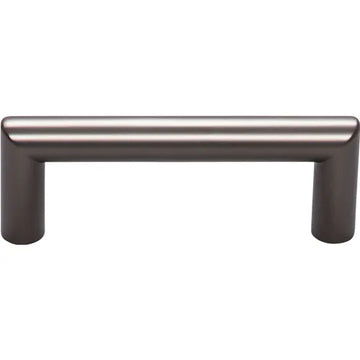
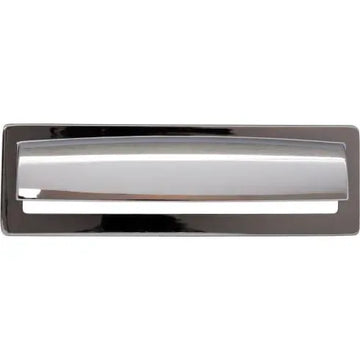
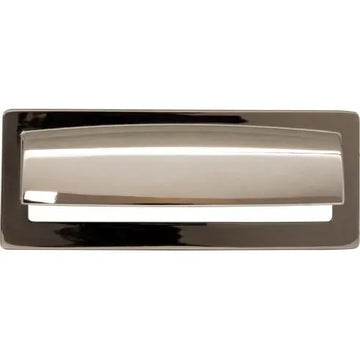
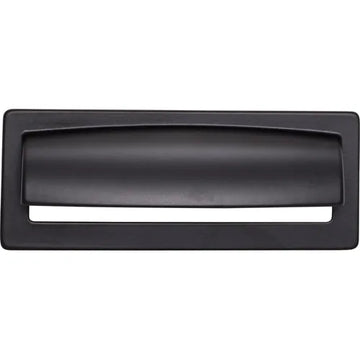
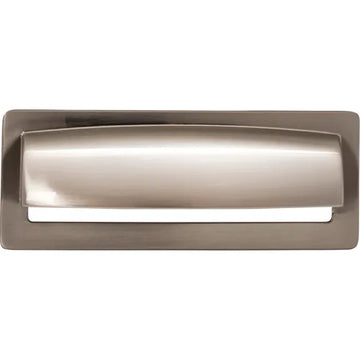
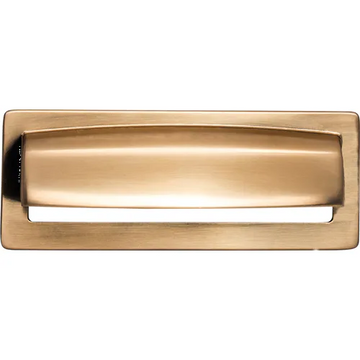
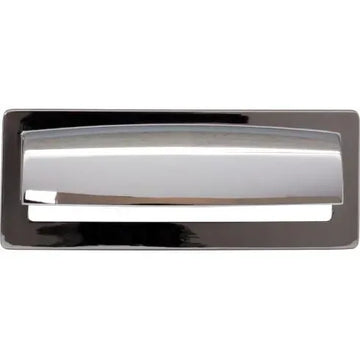
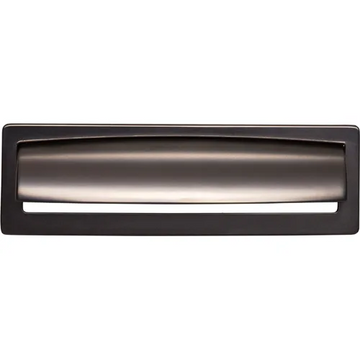
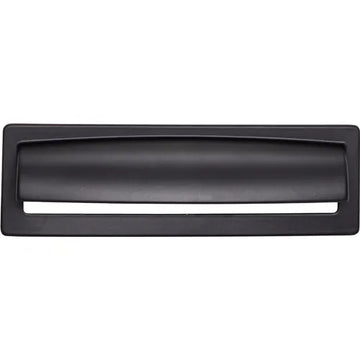
Concave pulls that curve into the cabinet face
Concave pulls reverse the standard convex curve and dip inward toward the cabinet between the two mounting screws. Instead of arcing outward like a bow pull, the grip pulls back, leaving a hollow that the fingers slide into from below. The visual effect is unusual — most cabinet hardware sticks out from the face, while a concave pull sits flush or recessed. Done well, it gives a clean horizontal line broken by a single soft notch in the middle.
What the shape does for the cabinet
Concave pulls deliver a modern, minimal look while still giving the hand a defined grip point. The recess catches shadow under cabinet lighting, which reads more dimensional than a flat slab-front pull-free cabinet. They work well on flat-front contemporary kitchens where the designer wants visible hardware that still feels integrated rather than applied. The same shape can read mid-century when paired with walnut cabinetry.
Install and use notes
The cabinet face needs enough clearance behind the door to allow the standoffs and screws — concave pulls aren't a drop-in for cabinets designed for surface-mount hardware unless the recess depth is shallow. Read the projection spec before ordering. The grip recess is usually wide enough for two fingers; concave pulls aren't a great match for cooks with larger hands who pull drawers loaded heavy. For those drawers, a standard bar pull stays more comfortable in daily use.
Where concave pulls fit in the catalog
Within the wider pull category, concave forms read closest to tab and edge pulls in that both reduce the pull's visual footprint. The difference is the grip mechanism: tab and edge pulls disappear into the door edge, while a concave pull stays on the face but recesses into it.
Frequently Asked Questions
What makes a concave pull different from a standard convex or bow pull?
A concave pull curves inward toward the cabinet face between the two mounting screws, creating a hollow that fingers slide into from below. A bow or convex pull arcs outward away from the cabinet face. The practical result is that a concave pull sits flush or recessed rather than projecting visibly into the room, producing a cleaner horizontal line on the cabinet face.
Where do concave pulls work best in a kitchen or bath?
Concave pulls are well-suited to flat-front contemporary kitchens where visible hardware is desired but should feel integrated rather than applied as an accessory. The same form can read mid-century modern when paired with walnut cabinetry. Because the recess catches shadow under cabinet lighting, they read more dimensional than a completely pull-free slab-front cabinet.
How do concave pulls compare to tab and edge pulls?
Concave pulls and tab or edge pulls are similar in that both reduce a pull's visual footprint on the cabinet face. The key difference is grip location: tab and edge pulls disappear into the door edge entirely, while a concave pull remains on the face but recesses into it, providing a visible but low-profile grip point.
Are there installation or ergonomic considerations before ordering concave pulls?
The cabinet face must have enough clearance behind the door for the standoffs and screws, so concave pulls are not always a direct substitute for cabinets designed for surface-mount hardware — the projection spec should be confirmed before ordering. Ergonomically, the grip recess typically accommodates two fingers comfortably, but for heavy-use drawers or users with larger hands, a standard bar pull generally provides more comfortable daily grip.
What Customers Say
Trusted by thousands of designers, builders, and homeowners
Kayla Malo is the most attentive and super human ever! My experience with this company is stellar!

Love working with Kayla, she is extremely helpful and quick with responding to my questions!
Kayla was GREAT!!!! Super help and fast answers. One of the best I've ever dealt with.